

This is a remastered version of an article I published in October 2020 which can be found here: The Puzzle of Friendship: Yu-Gi-Oh! Volume 1 Review
Like most people my age, I was introduced to the world of Yu-Gi-Oh! through the English dub of the Yu-Gi-Oh! Duel Monsters anime (titled Yu-Gi-Oh! in the U.S.); but unlike most people my age, I didn’t join the fad in 2002 when it first came out. I got into Yu-Gi-Oh! in 2009, when I was 14 years old.
As an outsider to the Yu-Gi-Oh! franchise, the story seemed a bit bizarre to me. I might be stating the obvious here, but the main character looked…weird, and his voice sounded a little too deep for his appearance. I also found it strange that the characters in the show played the card game against each other instead of battling with their monsters like they do in Pokémon. It seemed like the show was inherently created to sell the trading cards. I even remember seeing a commercial for a toy duel disk and wondered why anyone would want that thing.
In the summer of 2008, my current Saturday morning cartoon block was KidsWB on the CW. To this day, KidsWB remains one of my favorite Saturday morning cartoon programs, with its run of memorable shows such as Johnny Test, Magi Nation, Legion of Super Heroes, Teen Titans, The Batman, and yes, even The Spectacular Spider-Man. However, at the beginning of that summer, the network announced that the Saturday morning cartoon block would soon change to the CW4Kids. Yes, for whatever reason, 4Kids was moving their block of Saturday morning cartoons from Fox to the CW. They began by airing episodes of Yu-Gi-Oh! GX, Chaotic, and TMNT: Fast Forward. I wasn’t too thrilled about any of these new shows, but since I didn’t have anything better to do on my Saturday mornings, I decided to give them a try.
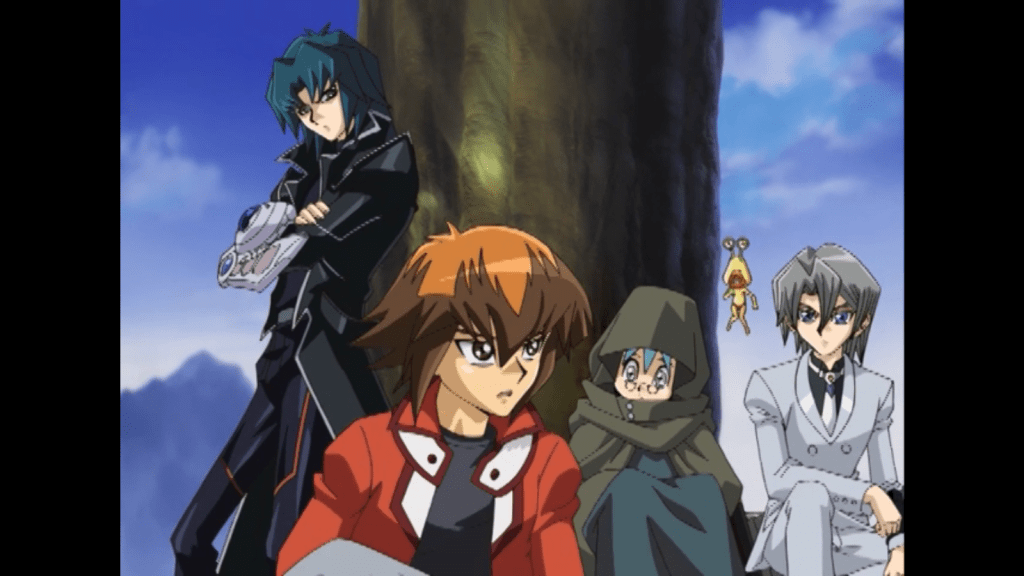
You know how sometimes you watch a show, and it usually ends up being better or worse than you thought it would be? Well, I started watching Yu-Gi-Oh! GX, and wouldn’t you know it, the show was exactly as weird as I thought it would be. The characters all looked weird, they talked quickly with little space in between each other’s lines, and there were bizarre creatures floating around them. Funny enough, the first episode of Yu-Gi-Oh! I ever saw was the GX episode, “The Forbidden Ritual: Part 1”, which has Exodia in it, even though it wasn’t the actual first episode. Also, this may have been a weird place to enter the series as characters who lose duels in this arc just straight up die.
So I kept watching Yu-Gi-Oh! GX, but it never quite resonated with me. In the fall of 2008, the CW4Kids premiered the first episode of Yu-Gi-Oh! 5D’s. I didn’t get into the show at first, but the more I watched it, the more I started to actually enjoy it. The network played the series until the start of the Dark Signer arc; then, one year after the show began, the CW4Kids announced they would be putting Yu-Gi-Oh! 5D’s on hiatus. In the meantime, they would begin playing episodes of the original Yu-Gi-Oh!. I thought to myself that this show would be even worse than GX, but I would soon consider this moment to be one of the worst misjudgments I have ever made.
As the original Yu-Gi-Oh! began, it seemed like a typical kids show made to get kids hyped about its marketable content, but once it got to the third episode, something began to change my perspective of the show. In the middle of the third episode, the main character, Yugi, recounts the story of how he met his best friend, Joey. As the story goes, Joey used to pick on Yugi and one day stole his Millennium Puzzle, Yugi’s most prized possession. He took a piece of the Millennium Puzzle and threw it out the window, landing it in a pool. Soon after, Joey found himself on the receiving end of bullying from a much bigger student. Despite picking on him earlier, Yugi decided to stand up for Joey and take a few of the bigger bully’s blows. What started to change my perspective of this show was the character of Yugi and how he had the courage to stand up for someone even though he was picking on him. As I continued to watch Yugi fight his way through Duelist Kingdom to defeat the evil Pegasus and rescue his grandfather, Yugi stated to become the ideal model of a hero in my eyes.
Yu-Gi-Oh! would become one of my biggest examples of not judging a book by its cover, as the show would soon become one of my favorites, and Yugi Muto would become one of my favorite characters.
Years later, when I entered my first year of college, I began my third run of the series. When I watched that third episode again, I started to suspect that there was more to this story than what was shown, as in, there were important events that happened even before the first episode. My searches led me to discovering the Yu-Gi-Oh! manga, and sure enough, the first chapter tells that story from the third episode – the story of how Yugi and Joey met.
The Beginning
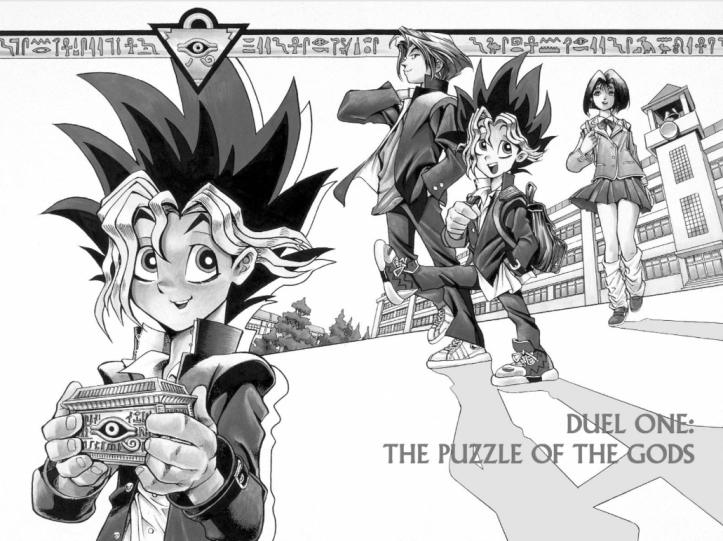
In the beginning of the first chapter of the Yu-Gi-Oh! manga, we get our first introduction to the character of Yugi Muto. The chapter begins with Yugi sitting alone in his classroom playing with a toy. One of the other students asks Yugi if he wants to play basketball, but Yugi says that any team he is on just ends up losing. (Something I think any true gamer could relate to.) Yugi wishes he could play his kind of games with someone as he pulls out of his backpack his most prized possession – the Millennium Puzzle. Yugi is confident that he will solve the puzzle today, but before he can open the box, it suddenly gets swiped away from him.
We now get our first introduction to the characters of Joey and Tristan, but in the English translation of the manga, these characters retain their Japanese names, so Joey is Jonouchi and Tristan is Honda. Jonouchi and Honda pick on Yugi for ogling at a jewelry box like some kind of girl. Jonouchi wants to teach Yugi how to be more manly, so he tries to get Yugi to throw a punch at him, but Yugi screams that he hates fighting and violence. This is the twist that manga creator Kazuki Takahashi wanted to add to his shonen story. When Takahashi was generating ideas for a manga story, he knew he wanted to write a battle story, but with all of the fighting manga that already existed, he found it difficult to come up with something original. I mean, it’s not like he could just take the characters from Dragon Ball and make them all ninjas, or make them all pirates. That wouldn’t be successful. Takahashi decided to create a protagonist who doesn’t fight with his fists, but instead becomes a hero whenever he plays games. Now you may be asking how a shonen protagonist is going to survive if he doesn’t fight physically. Well, we’ll get to that.
Jonouchi and Honda begin playing keep away with Yugi’s Millennium Puzzle. Being short in stature, Yugi has no chance of getting it back, that is until his childhood friend shows up to get him out of trouble. Now, we get our first introduction to the character of Téa, or Anzu in the manga. Through narration, Yugi introduces Anzu as a cute but stubborn girl, and apparently her stubbornness is enough to scare Jonouchi and Honda out of the classroom. Anzu returns the Millennium Puzzle back to Yugi and encourages him to be tougher when dealing with bullies. She inquires as to what is inside Yugi’s box, so he decides to show her. Yugi opens his box and reveals an assortment of sparkling puzzle pieces that look as if they are made out of pure gold. Yugi tells Anzu that the Millennium Puzzle was discovered in an Egyptian ruin. He found it one day in his grandpa’s attic, and his grandpa dared him to solve it. It’s been eight years now and he still hasn’t solved the puzzle yet. Anzu gives Yugi a reassuring word that he will solve the puzzle as long as he keeps his heart in it.

Meanwhile, outside the classroom, Jonouchi and Honda are discussing how mad Anzu makes them for calling them bullies. Not watching where they are going, they run into a big, bulky hall monitor named Ushio. Overhearing their discussion, Ushio gives them an intimidating glance and politely reminds them that bullying people is wrong. Honda quickly pulls Jonouchi away before he can pick a fight with him. Once they get away from Ushio, Jonouchi reveals to Honda that he stole a piece of Yugi’s Millennium Puzzle when he wasn’t looking. Going off about how much Yugi pisses him off, Jonouchi throws the puzzle piece out of a window, and it lands in the school’s pool.
The next day, Yugi finds that Jonouchi and Honda have been beaten up by Ushio. The bulky hall monitor says he overheard they were picking on him, so he offers to become Yugi’s personal bodyguard. As payment for his services, Ushio demands Yugi pay him 200,000 yen. When Yugi refuses, he threatens to hurt Jonouchi and Honda some more. Yugi courageously stands between Ushio and his victims and demands that he stop hurting them. Ushio decides to teach Yugi a lesson about who’s in charge around here by assaulting him several times. At this point, Jonouchi begins to see Yugi’s true strength. Yugi is strong not because he exercises physical dominance over other people, but because he is willing to stand in harm’s way to protect those he cares about. After Ushio finishes beating Yugi, he tells him to bring the money tomorrow, or he will teach him even more pain with the knife he has hidden under his jacket.
Yugi returns home and starts thinking about how he is going to pay Ushio, but he keeps getting distracted trying to solve the Millennium Puzzle. Yugi notices that for some reason, solving the puzzle seems easier today. After many successful clicks, Yugi finally solves the puzzle – except for one piece. He reaches inside the box for the last piece, but it’s gone! He tears apart his entire room, but cannot find it. Grandpa walks in and sees Yugi’s dilemma. He encourages Yugi to have more faith and reveals the last piece of the puzzle in his hand. Grandpa promised not to tell Yugi, so we hear in his thoughts that Jonouchi had brought the puzzle piece to Grandpa. Jonouchi also said that they were getting bullied by a guy named Ushio, who is threatening Yugi pay him, so Grandpa puts some money in Yugi’s backpack.
But as it turns out, the money will only be the second most useful thing to confront Ushio with, because as Yugi inserts the last piece into the Millennium Puzzle, he awakens an ancient Egyptian power that creates a dark, alter-ego of himself.

The First Shadow Game
If I were to describe Yu-Gi-Oh! with only two images, it would be a picture of Yami-Yugi and the back of a Yu-Gi-Oh! card. For a franchise that seems inseparable from a trading card game, it was surprising for me to find out that the series, originally, had nothing to do with card games. Instead, the series initially revolved around the concept of Shadow Games. As the prologue explains, Shadow Games are magical ceremonies from ancient Egypt that determined the fates of citizens and kings. When Yugi solved the Millennium Puzzle, he awakened within him the powers of the Shadow Games and will now use them to determine Ushio’s fate.
Yugi calls Ushio and tells him to come to the school grounds in the middle of the night, but when Ushio gets there, he sees someone quite a bit different from the childhood hero of the anime.
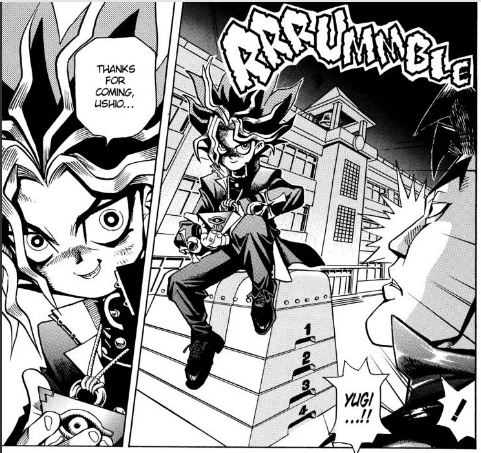
Yugi’s alter-ego, known as Yami-Yugi or Dark Yugi, but mostly referred to as Yugi, thanks Ushio for coming and says he brought 400,000 yen instead of the requested 200,000. He says that just handing over the money would be too boring, so…he challenges Ushio to a Shadow Game. Enticed by the amount of money he can earn, Ushio accepts the challenge. Yugi asks to borrow the knife Ushio has, so Ushio gives it to him, although I’m not sure how Ushio doesn’t suspect this as a trick. Yugi says that to play this game, they will take turns placing a pile of money on the back of their hand, then with their other hand, they will use the knife to stab the money without hurting their hand. The player will keep however many bills they manage to pick up with the knife. They will keep playing until all of the bills are gone. (Yeah, these Shadow Games are quite a bit different from the kid-friendly card games of the anime.)
The Shadow Game begins. Yugi and Ushio take turns stabbing the money without stabbing their hands. Ushio plays the game by Yugi’s rules, but as he is about to claim the rest of the money, he suddenly loses the power to relax his arm. Yugi explains that in a Shadow Game, a person’s true nature is revealed. Ushio’s right arm is now controlled by his own greed; he cannot stop it from stabbing the money and his hand, so he comes up with another strategy. Ushio tries to stab Yugi with the knife, but since Ushio broke the rules, the powers of the Shadow Games will protect Yugi from harm. Yugi dodges the attack, and now a glowing eye appears on his forehead. He says this eye can only be seen by those who trespass into his soul. Since Ushio broke the rules of a Shadow Game, he is now subject to receive a Penalty Game. These are curses that a player will receive if they break the rules or lose in a Shadow Game. Yugi gives Ushio a Penalty Game that makes him see money falling from the sky, trapping him within the illusion.
The next day at school, Jonouchi thanks Yugi for standing up to Ushio for him. Then he offers to be Yugi’s friend by making a pun out of their names. It’s not depicted in the English version, but Jonouchi combines the first two letters of his and Yugi’s names to make the Japanese word “yu-jo“, which means “friendship”.

The next few chapters introduce us more to the concept of shadow games by giving Yugi some fodder villains to fight.
In Chapter 2, Yugi fights a corrupt TV producer for filming him getting assaulted on his school grounds. He challenges the producer to a simple die roll and says whoever rolls the lower number wins the game, and if they tie, the producer will win. The producer says he doesn’t have time to play such a childish game, but when he sees Yugi roll a six, he laughs and makes fun of him for automatically losing. Yugi says the game isn’t over until the producer rolls, so the producer throws the die at Yugi’s face. Yugi uses the Millennium Puzzle to shield himself, but this causes the die to split in two, with one half landing on six, and the other half landing on one, which means that the producer rolled a 7 with a single die. Since the producer rolled a higher number, he loses the Shadow Game. Yugi gives him a Penalty Game that causes him to see the world through a pixelated censorship.
One common criticism of Yu-Gi-Oh! is that adults and villains will resort to playing a children’s trading card game in order to resolve their disputes, instead of using more aggressive means. What we see in these shadow games is that Yugi always entices his opponents into playing by making them believe they can gain something out of it. For Ushio, Yugi entices him with money. For the producer, he makes him think he can’t lose. In this way, Yugi isn’t just trying to defeat his enemies, but he is also trying to fulfill his wish of ‘wanting to play his kind of games with someone’ in a rather sadistic way.

The Diner Incident
When we get to Chapter 4, we get a more formal introduction to the character of Anzu. As mentioned in the beginning of Chapter 1, Anzu has been Yugi’s friend since childhood, but in Chapter 4, Yugi and Jonouchi start to notice that Anzu has been acting strange lately. She hasn’t walked home with them in a few days and is always too busy to hand out with them after school. Jonouchi suspects Anzu is going on sugar daddy dates (yes, Jonouchi is that kind of guy), so they decide to follow her.
Yugi and Jonouchi follow Anzu into the city until she enters a burger joint, and when they approach the door, Anzu comes out in a waitress uniform to greet them. (Apparently, she also doubles as a fast-changer.) When Anzu realizes she is greeting her friends, she panics because their school doesn’t allow them to have part-time jobs. She is worried that Jonouchi will tell on her. Anzu confronts them later in the restaurant, but they promise not to tell.
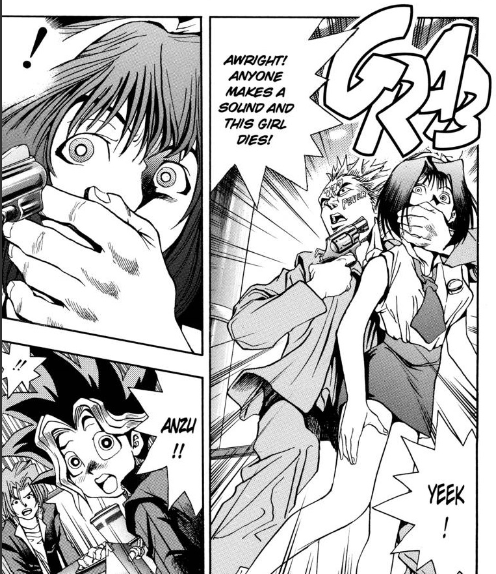
Soon after, Anzu goes to greet another customer, but it turns out to be an escaped convict! He holds Anzu hostage and tells everyone else to get on the ground. He blindfolds Anzu and sets her down at a table, then he makes Yugi serve him booze and cigarettes. Anzu warns Yugi to stay back, but this only causes the prisoner to slap her on the cheek. Seeing his beloved friend getting abused, Yugi becomes filled with rage and transforms into his alter-ego. He sits down across from the prisoner and challenges him to a Shadow Game. For this game, each player is to choose one of their ten fingers to move, the other must remain completely still. The prisoner gets enticed to play this game because he considers himself super lucky and wants to amuse himself. The prisoner choses his right index finger, as it is already on the trigger of his gun. Yugi chooses his right thumb.
As Anzu remains blindfolded, she listens to the person who is trying to save her. She notices the voice sounds like Yugi’s, but more confident. She isn’t sure who the voice belongs to.
As soon as the game begins, the escaped convict prepares to use his right index finger to squeeze the trigger of his gun, but Yugi uses his thumb to ignite a lighter. The convict orders Yugi to light his cigarette as his last act on Earth, but after Yugi does so, he places the lighter on the prisoner’s left hand, which is currently pouring vodka.

If the prisoner suddenly moves, the lighter will fall and set the vodka on fire. I’m sure anyone would instinctively grab the lighter and move it off, but the prisoner just sits there for some reason. Yugi pulls Anzu away before the flames engulf them, and then we witness our first death by Shadow Game.
And now, Yugi can honestly say, “I killed a man with this thumb.”

Anzu removes the blindfold to see who her savior is, but when she opens her eyes, all she sees is Yugi. From then on, Anzu fell in love with the man she knows only as “the one who saved her with a game.”
The next two chapters give us more fodder villains for Yugi to fight while also giving us more insights into the character of Anzu. Like in Chapter 6, we learn that Anzu takes on the role of a leader by organizing her class’s booth for their school festival. They all spit out ideas, but in the end, they decide to go with Yugi’s idea and build carnival games. Anzu managed to win the best spot on the festival grounds, right next to the entrance; but another class is not too happy, as they use that same spot every year to make okonomiyaki (which the translator tells us are like cabbage pancakes). Using their giant grill as a battering ram, they destroy the carnival games and reclaim the spot for themselves. Yugi tries to spot them, but he ends up getting injured and sent to the hospital.
Later that night, Yugi leaves the hospital and returns to the carnival grounds to challenge the other class leader to a Shadow Game. This time, they play a game of air hockey; but they use the heated grill as the rink and a block of ice as the puck. And since that’s not dangerous enough, the ice puck has a tube of explosives in the middle, meaning that the grill will continue to melt the puck until the tube makes contact with the heat, and then…KABOOM! As the Shadow Game begins, the class leader’s strength and speed become to much for Yugi to handle. So, Yugi uses his brains rather than his brawns to win the game. He uses the flat edge of his paddle to create a small crack in the ice. When the puck returns to the class leader, he uses his full strength to send the puck back, but he inadvertently cracks the puck in two. The tube of explosives makes contact with the heated grill, and then…KABOOM! (Kind of a dark ending for someone who just stole a carnival booth.)
What we see in all of these Shadow Games is that Yugi figures out how to defeat bullies twice his size by using his wits rather than his strength. He also manages to figure out how to win by using the most far-fetched methods, but still never breaks the rules.
Honda Joins the Party
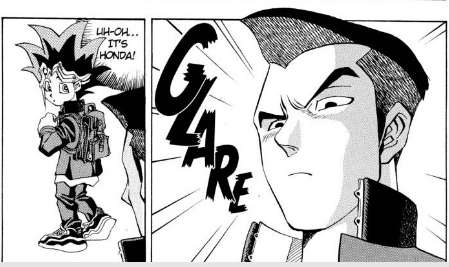
The seventh chapter formally introduces us to the character of Honda. If you remember, Yugi stood up to Ushio for both Jonouchi and Honda, but for some reason, only Jonouchi made friends with Yugi afterwards. Honda still hates him for some reason.
In the beginning of this chapter, Honda comes to ask Yugi for some help, and by that I mean Jonouchi is trying to persuade Honda that Yugi can help. You see, Honda has a crush on a girl in their class names Miho, so he is trying to find a way to convey his feelings to her. Yugi thinks his Grandpa might have something, so they go to his game shop to find out. Grandpa Muto presents them with a jigsaw puzzle. The idea is for Honda to write a note on this puzzle, disassemble it, and send it to Miho. When she solves the puzzle, she will be able to read the message. Honda likes the idea, but is too nervous to write the message, so he makes Yugi do it for him.
The next day, they slip the puzzle in Miho’s desk and hope for the best. When class begins, a moody teacher enters the room and demands that everyone empty their desks for a surprise inspection. Miho pulls out the package and is surprised to find it in her desk. The teacher confiscates the package and begins to assemble the puzzle. She reads the note out loud in front of the whole class. The teacher reminds the students that underage dating is against school rules and will expel whoever sent her the puzzle, but before she can finish the last four pieces and reveal the sender’s name, Yugi transforms into his alter-ego and turns the puzzle into a Shadow Game. As the teacher finishes the puzzle, the makeup of her soul starts to fall off like the pieces of a jigsaw puzzle, revealing her true face. The teacher runs out of the room before she can expel anyone.
In the end, Honda didn’t get the girl, but he did end up making friends with Yugi afterwards.
Puzzles and Friendship
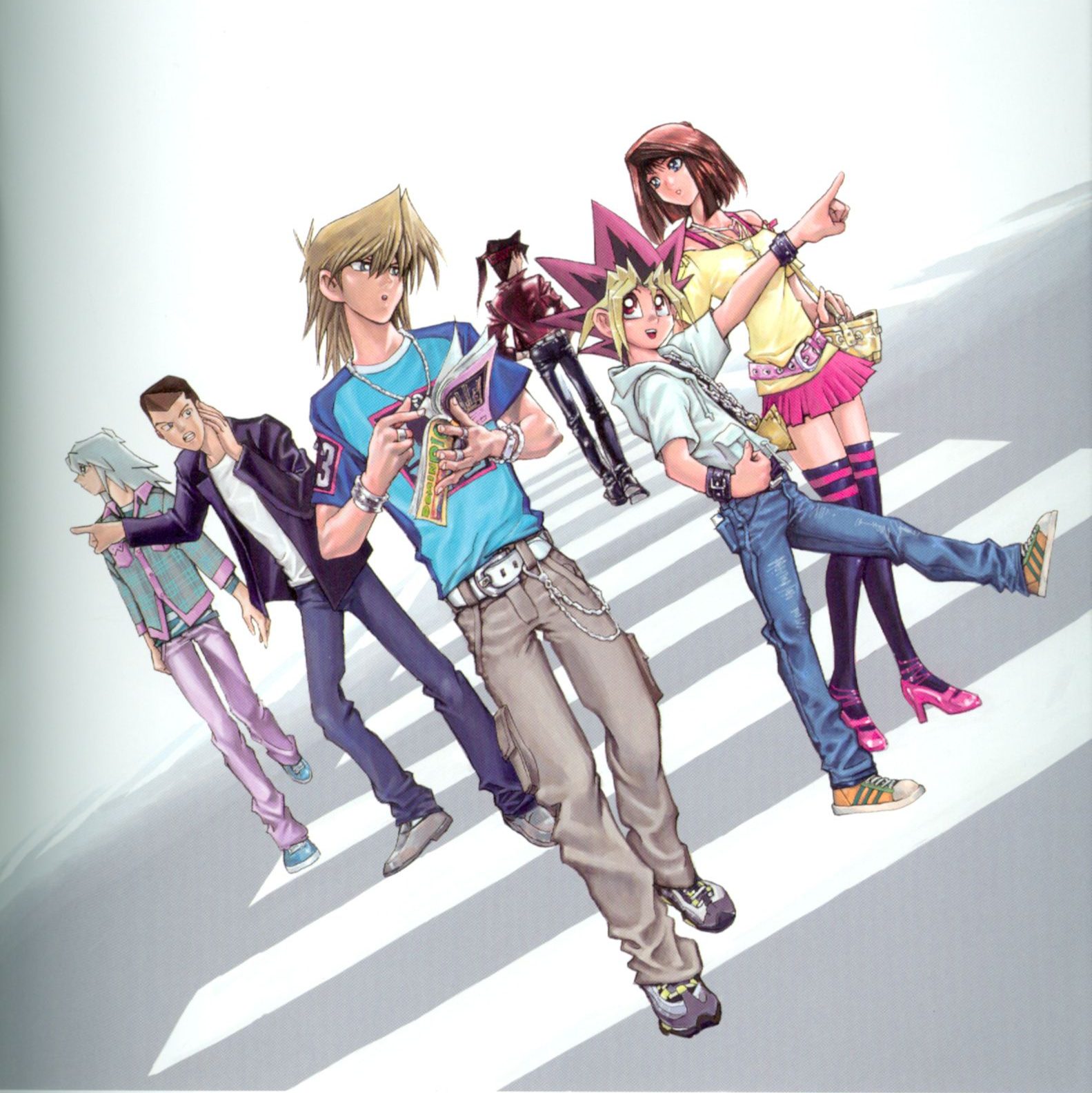
In this volume, Yugi assembled the Millennium Puzzle and acquired a dark alter-ego that allowed him to unleash judgments on evildoers by using the powers of the Shadow Games. Through his newly acquired powers, Yugi also assembled a collection of friends to help him fight through his troubles in life.
As we progress through the Yu-Gi-Oh! story, I hope to convince you that Kazuki Takahashi is a master of symbolism. As mentioned earlier, Takahashi wanted to write a story about a protagonist who doesn’t fight with his fists, but fights by playing games and solving puzzles. He said that the positive message of Yu-Gi-Oh! is that each person has a strong hidden part within themselves, and when one finds hardship, the hidden part can emerge if one believes in themselves and their friends. With both puzzles and friendship being major themes of the story, Takahashi decided to intertwine them into one philosophy – that just as the many little pieces of a puzzle combine together to create a greater whole, so can people join together as friends and help each other accomplish things that not one of them could do on their own. I know the theme of friendship usually gets beat to death in Yu-Gi-Oh! (especially in the English dub), but I do like how well this theme is portrayed throughout the entire course of the story.
Chapter 8 is another fodder villain fight, and with that, we have come to the beginning of the first episode. We’ll get into how the card game Duel Monsters was introduced into the Yu-Gi-Oh! story next time. Until then, be sure to stay safe while playing Shadow Games!
 Anime on the Mind